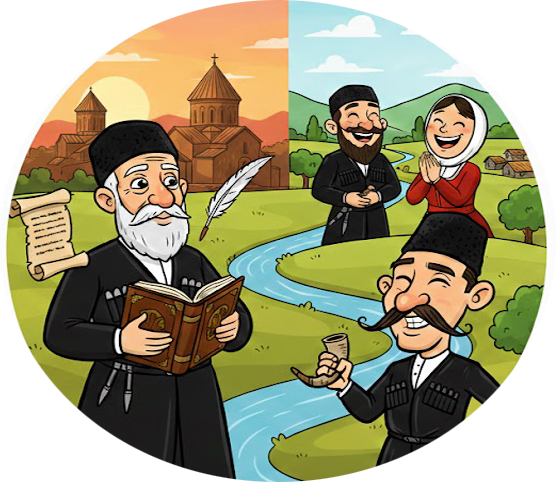

Khevsureti is a high mountainous territory , crossed by the deep gorges. It’s geographic name “Khev-sur-eti” is derived from here and means a place of deep gorges. Khevsureti has been populated with Georgian tribes since the olden times.The Khevsurs lived in a communal system,paid metayage to the Kakheti king and when necessary supplied an army to fight an enemy. Besides, they were distinguished for their bravery,love of their country and were known to be excellent warriors. Therefore they song:
I won’t swap my rocky mountains
For a perennial life somewhere
I won’t swap my sweet homeland
For a paradise elsewhere.
Ethnography
The territory of Khevsureti, together with the neighboring area of Pshavi was known to medieval writers under the joint designation Pkhovi. Despite the sporadic invasions by the royal troops, medieval Georgia was never able to establish a typical feudal system and the civil code of the community remained based on the ancient traditions and values incorporating chivalry, courtly love, the respect of individuality and family and the devoution to the homeland. The region adopted Christianity as an official religion several centuries after St. Nino and historically, the highlander communities of Khevsureti and the neighbouring areas enjoyed a degree of autonomy from the royal authorities. They were free of typical feudal relations and submitted directly to the monarch. They defended the borders and provided crack troops for the royal guards.
Even into the twentieth century, the Khevsur men, dressed in chain mail and armed with broadswords, wore garments decorated with crosses. They had a strict system of physical training in martial arts preserved as a warrior dance Khevsuruli, one of the finest examples of the Georgian choreography. They worshiped flags adorned with crosses and considered themselves permanent members of the army of the sacred flags and guards of Georgian kings.
Traditions
As other mountainous areas of Georgia, Khevsureti is characterized by a great diversity of traditions and customs. They speak a local dialect of the Georgian language that resembles the literary Georgian of the Middle Ages and retain many of their ancient traditions including element of folk rituals. Law of blood revenge was still alive in the twentieth century.
Musical traditions also resemble music of the Middle Ages. Khevsureti is famous for its Medieval ballads and folk music. Khevsureti Chokha is different from the classic Georgian, because it has more cross decorations and more powerful color balance and is generally short, shaped like a trapezoid.
I won’t swap my rocky mountains
For a perennial life somewhere
I won’t swap my sweet homeland
For a paradise elsewhere.
Ethnography
The territory of Khevsureti, together with the neighboring area of Pshavi was known to medieval writers under the joint designation Pkhovi. Despite the sporadic invasions by the royal troops, medieval Georgia was never able to establish a typical feudal system and the civil code of the community remained based on the ancient traditions and values incorporating chivalry, courtly love, the respect of individuality and family and the devoution to the homeland. The region adopted Christianity as an official religion several centuries after St. Nino and historically, the highlander communities of Khevsureti and the neighbouring areas enjoyed a degree of autonomy from the royal authorities. They were free of typical feudal relations and submitted directly to the monarch. They defended the borders and provided crack troops for the royal guards.
Even into the twentieth century, the Khevsur men, dressed in chain mail and armed with broadswords, wore garments decorated with crosses. They had a strict system of physical training in martial arts preserved as a warrior dance Khevsuruli, one of the finest examples of the Georgian choreography. They worshiped flags adorned with crosses and considered themselves permanent members of the army of the sacred flags and guards of Georgian kings.
Traditions
As other mountainous areas of Georgia, Khevsureti is characterized by a great diversity of traditions and customs. They speak a local dialect of the Georgian language that resembles the literary Georgian of the Middle Ages and retain many of their ancient traditions including element of folk rituals. Law of blood revenge was still alive in the twentieth century.
Musical traditions also resemble music of the Middle Ages. Khevsureti is famous for its Medieval ballads and folk music. Khevsureti Chokha is different from the classic Georgian, because it has more cross decorations and more powerful color balance and is generally short, shaped like a trapezoid.